


Exhibition
Artificial Nature
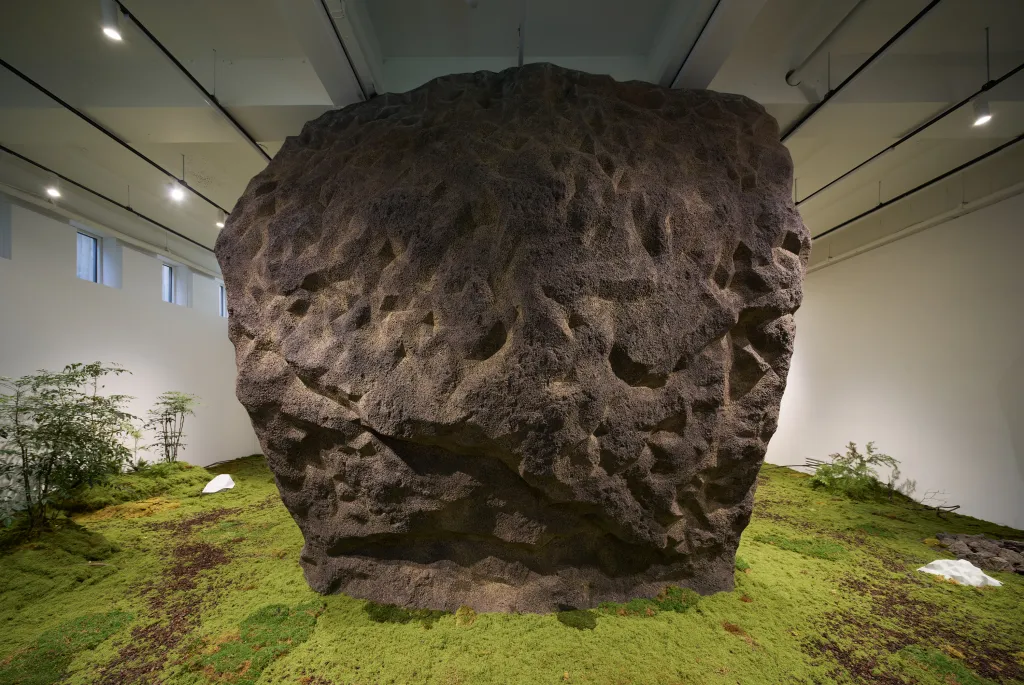
INSTALLATION VIEW “Artificial Nature“, 2025. Courtesy of the Artist and THEO.
What is nature? Taesoo Lee approaches this enduring question not with definitions, but with forms, fragmented, ambiguous, and deeply sculptural. In his latest exhibition , Lee explores the porous boundaries between nature and artificiality, material and immaterial, the real and the rendered. At the heart of this inquiry lies a paradox: he carves one of the most elemental and ancient materials, stone, into shapes that echo the hyper-digital language of polygons and 3D modeling. But these are not merely sculptures that mimic digital aesthetics. Rather, they are provocations, tactile meditations on what it means to construct, perceive, and believe in “nature” within an age saturated by simulation.
For Lee, nature is not a fixed, external truth. It is something that accrues meaning through time, something that becomes natural through familiarity. A dolmen, once a human construction, becomes part of the landscape over millennia. A path in the forest, shaped by repeated footsteps, comes to feel inevitable and organic. Even the cars we drive, artificial in essence, now blur seamlessly into our everyday scenery. Nature, in this view, is not an opposition to artifice but a fluid, perceptual category, one that is constantly being negotiated.
In <Artificial Nature>, Lee chooses stone for its weight, its history, its resistance. Yet he imposes upon it the clean geometries of digital space, polyhedral forms that usually exist only on screens. From a distance, these works resemble 3D renderings suspended in real space. Up close, they assert their mass, texture, and temperature. The viewer is caught in the friction between what is seen and what is felt, between surface illusion and material truth.Lee’s works resist being reduced to clever inversions or optical tricks. He doesn’t merely imitate the digital, he reclaims it as a sculptural language, one capable of carrying weight, duration, and memory.
In doing so, he invites us to reconsider not just what we see, but how we sense the world around us. Artificial Nature is a study in thresholds, between perception and substance, the analog and the digital, the familiar and the strange. It is in these shifting zones that Lee finds a new language for sculpture, one that is both grounded and speculative, ancient and contemporary.
Taesoo Lee’s latest body of work unfolds across four key trajectories that define the landscape of contemporary sculpture.
First, his sculptures subvert the tradition of trompe-l’œil, the classical technique of “deceiving the eye.” Historically rooted in painting, this method relies on visual illusion to mimic physical reality. Lee, however, reverses this logic. By working in sculpture, a medium grounded in material truth, he creates forms that appear artificial, despite being made of real stone. His is an anti–trompe-l’œil strategy in which authenticity is disguised as simulation.
Second, his work extends the legacies of Minimalism and Conceptual Art, particularly as developed by artists like Donald Judd and Robert Morris. Judd’s notion of “specific objects,” which emphasized the objecthood and materiality of sculpture, and Morris’s structural repetition and focus on material process both find echoes in Lee’s practice. Yet in Lee’s hands, these ideas are reinterpreted and pushed further. His structures, though physically real, operate as images before they are perceived as objects. The stone no longer functions purely as matter. Its surface takes precedence, becoming a coded visual structure that evokes the logic of simulation.
In an era where digital images often replace physical reality, Lee’s use of stone to render virtual geometries serves as a conceptual device. These polygonal forms, carved from actual rock, challenge our assumptions about what is real. The work resonates with Jean Baudrillard’s concept of the simulacrum, where representations begin to function as a reality more convincing than the original. Within this framework, Lee’s sculptures invite viewers to reflect on the kinds of structures they instinctively believe in and to consider how images shape their perception of reality.
Artificial Nature exists at a set of charged intersections: between material and image, nature and artifice, substance and illusion. Lee brings digital aesthetics into dialogue with sensory experience, and aligns data with physical weight and the organic with the constructed. Through this synthesis, he reveals how much of what we consider natural is in fact the product of deliberate construction. His work becomes a reflection not only on the environments we move through, but also on the ways we perceive, interpret, and assign meaning within the world, including the very role of art in shaping that understanding.
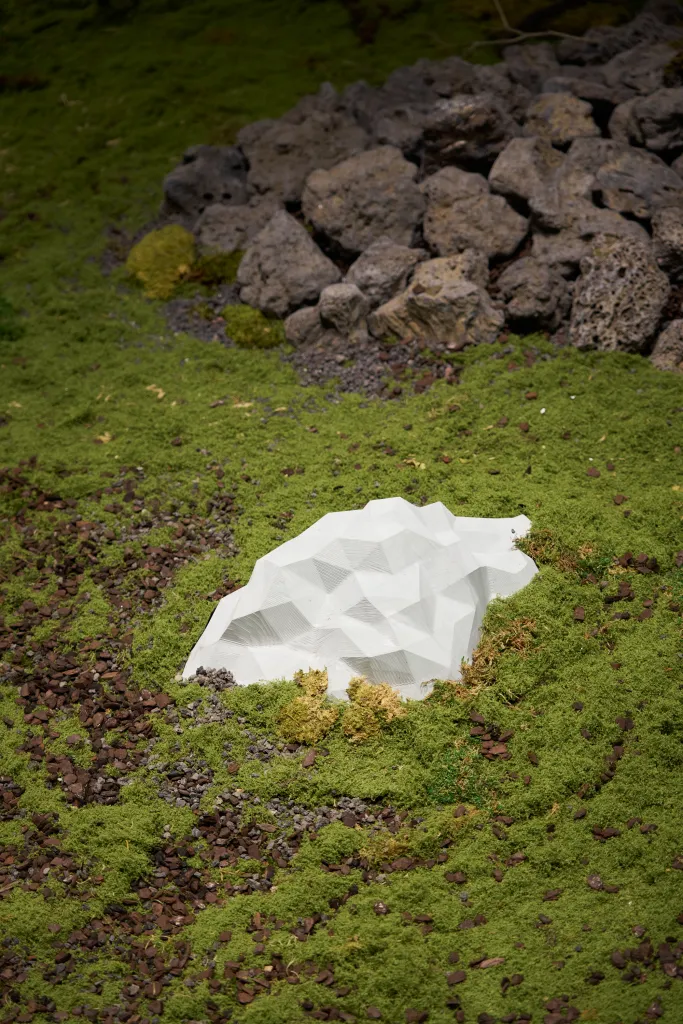
INSTALLATION VIEW “Artificial Nature”, 2025. Courtesy of the Artist and THEO.
자연이란 무엇인가. 이태수는 이 오래된 질문에 조각으로 답한다. 이번 전시 〈Artificial Nature〉는 자연과 인공, 물질과 비물질, 실재와 이미지 사이의 경계를 조형적으로 탐구하는 작업이다. 그는 가장 물질적인 재료인 돌을 사용해, 가장 비물질적인 조형 언어인 디지털 폴리곤의 형상을 구현한다. 이는 단지 ‘디지털처럼 보이는 조각’이 아니라, 현실의 물성을 기반으로 한 ‘인위적 자연’에 대한 질문이다.
이태수에게 자연이란 고정된 실체가 아니라, 시간의 축적 속에서 ‘익숙해진 것’을 의미한다. 사람의 손으로 만든 고인돌이 수천 년을 지나며 자연처럼 보이게 된 것처럼, 반복된 동선 위에 생긴 숲길이 어느새 자연스럽게 인식되듯, 자연은 어느 순간 인간의 감각과 인식 속에서 구성되는 개념이다. 우리가 타고 다니는 자동차도, 본질적으로는 인공물이나 이제는 풍경의 일부로 인식된다. 이태수는 이러한 관찰을 바탕으로, 자연과 인공의 경계는 얼마나 유동적이고 취약한 것인가를 묻는다.
〈Artificial Nature〉에서 그는 돌이라는 가장 원초적이고 무거운 물질을 선택하지만, 그 형상은 디지털 모델링 소프트웨어에서나 볼 수 있는 다면체 구조를 따른다. 멀리서 보면 렌더링된 가상의 덩어리처럼 보이지만, 가까이 다가가면 단단한 돌의 질감과 온도, 무게가 손끝에 전해진다. 이처럼 물리적 실체와 시각적 위장이 충돌하는 지점에서 관람자는 자연과 인공, 실재와 이미지 사이에서 감각적으로 흔들린다. 그 틈에서 우리는 무엇이 진짜이고, 진짜처럼 보이는 것은 또 어떤 의미를 갖는가에 대한 근본적인 질문에 맞닥뜨리게 된다.
이 조형 실험은 단지 시각적 착시나 재료의 반전만으로 설명되지 않는다. 이태수는 디지털 감각의 표면을 단지 차용하는 것이 아니라, 그것을 조각의 본질적 방식으로 전유한다. 물질성을 부정하는 듯한 폴리곤의 구조는 오히려 돌이라는 재료 안에 또 다른 시간과 무게를 새겨 넣는다. 이는 동시대 미술에서 시각과 감각, 이미지와 실체, 아날로그와 디지털 사이의 경계가 얼마나 조형적으로 교란될 수 있는지를 보여주는 한 사례다.
그의 이번 작업은 동시대 조각이 직면한 주요한 네 가지 맥락 위에 놓여 있다.
우선, 그의 작품은 트롱프뢰유(Trompe-l’œil)의 전통을 전복한다. 이는 고전 회화에서 기원한 ‘눈속임’의 기법으로, 시각적 환영을 통해 물리적 실재를 흉내 내는 데 집중하지만, 이태수는 조각으로 이를 구현하면서 오히려 ‘진짜임에도 가짜처럼 보이게 만드는 반(反)트롱프뢰유’의 전략을 사용한다[1].
또한, 그는 도널드 저드(Donald Judd)나 로버트 모리스(Robert Morris) 이후 전개된 미니멀리즘 및 개념미술의 문법을 계승하면서도 이를 확장한다. 저드가 주장한 ‘특수한 오브제’(specific objects)의 물성 중심 조각 개념[2]이나, 모리스의 반복성과 물질 기반 구조[3]는 이태수의 ‘진짜를 가장한 가짜 구조’에 대한 실험과 긴장 속에 비틀린 채 담겨 있다. 이태수의 돌은 더 이상 물질 그 자체로 기능하지 않으며, 그것의 표면 언어는 이미지로서의 구조를 선행한다.
디지털 이미지가 실체를 대체하는 시대에, 진짜 돌로 구현된 가상의 형상은 실재에 대한 인식 자체를 되묻는 장치가 된다. 이는 장 보드리야르(Jean Baudrillard)가 말한 시뮬라크르(simulacra) 실재보다 더 실재처럼 기능하는 이미지의 개념과도 맞닿아 있다[4]. 관람자는 이태수의 조각을 통해, 실체 없는 구조물에 의미를 부여하거나, 이미지가 지배하는 현실을 사유하게 된다.
〈Artificial Nature〉는 물질이자 이미지이고, 자연이자 인공이며, 실체이자 환영이다. 이태수는 디지털과 감각, 데이터와 물성, 자연과 인공이라는 대립적인 쌍을 맞물리게 하며, 지금 우리가 ‘자연스럽다’고 여기는 것들이 사실은 얼마나 인위적인 결과물인지 드러낸다. 그것은 우리가 살아가는 환경뿐 아니라, 인식과 감각, 그리고 예술 자체에 대한 성찰로 이어진다.
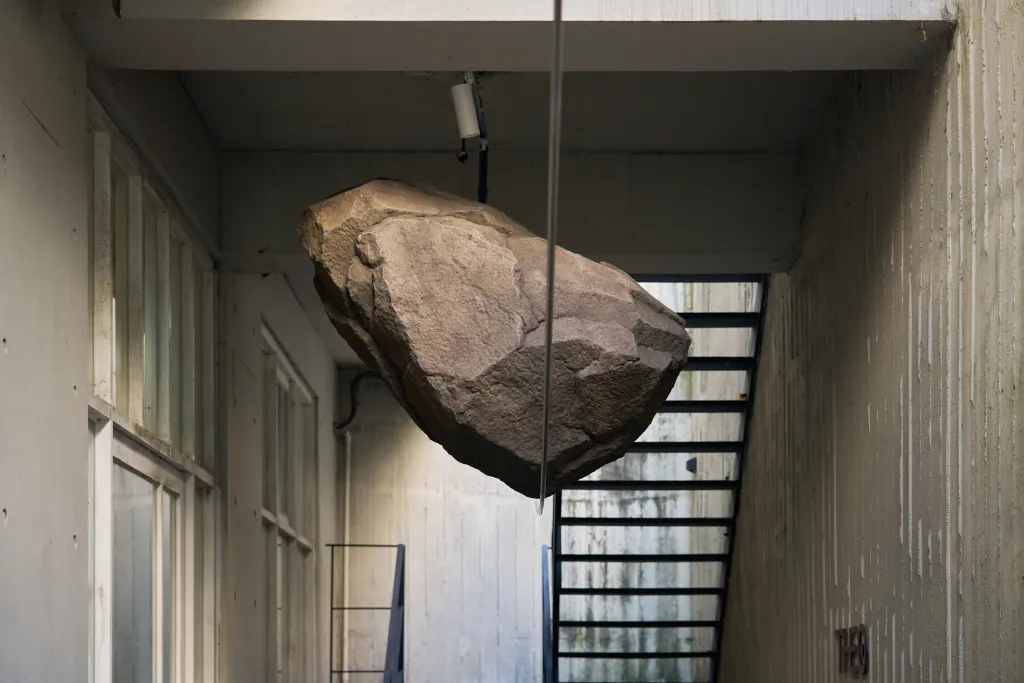
INSTALLATION VIEW “Artificial Nature”, 2025. Courtesy of the Artist and THEO.
2025. 11. 25. (Tue) – 2025. 12. 13. (Sat)
THEO (Seoul)