


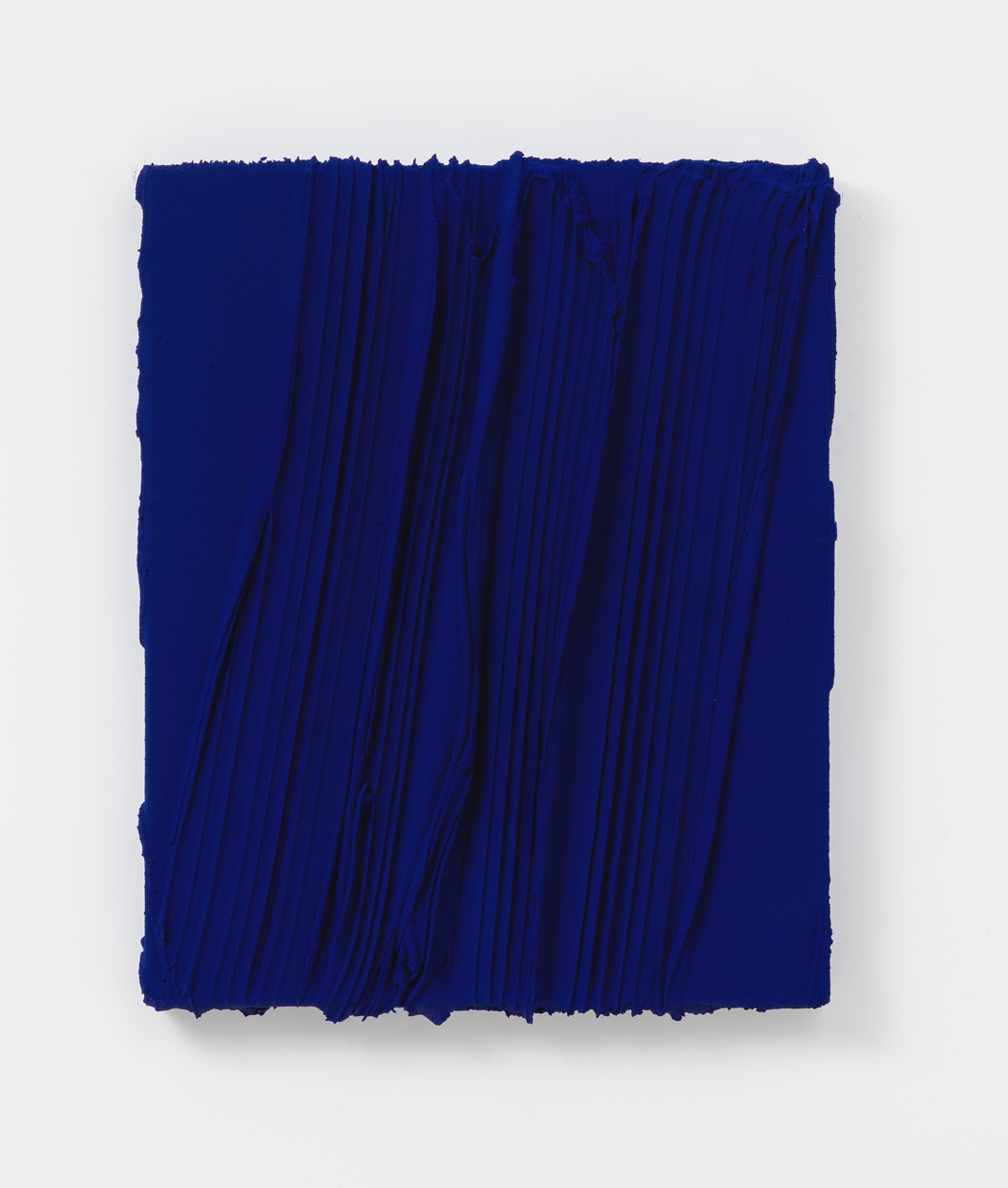
Jason Martin
Jason Martin interrogates the fundamental elements of painting with bold, minimal abstractions that approach sculptural dimension. The British artist, who divides his time between London and Lisbon, garnered international attention with his participation in the controversial 1997 exhibition Sensation: Young British Artists from the Saatchi Collectionat the Royal Academy of Arts in London. There, his work stood apart from that of the other YBAs presented because, rather than discarding genre or employing shock tactics, his paintings evince a deep engagement with modernist questions of medium specificity.
As a student at Goldsmiths in the early 1990s, Martin began to manipulate skins of striated oil paint or acrylic gel with a bespoke comb-like tool. He has refined this technique over the course of his career, developing complex modes of processing paint that allow control and chance to together structure his surfaces.Working with pure pigment, graphite, acrylic, andoil paint on aluminum, stainless steel, or Plexiglas grounds, he reduces the terms of his explorationto color, texture, and medium, finding abundant compositional possibilities within these constraints. The resulting paintings offer subtle, modulating gradients or intensely saturated monochromes, in which dense and gestural brushstrokes project out from the substrate in dramatic relief.
Across his paintings, Martin achieves a vivid physicality. Grooves, ridges, crags, and accretions index the artist’s movement over the surface of the work, tracing a choreography of artistic production while suggesting atmospheric topographies. While his exhaustive and iterative exploration of the materiality of paint recalls the ethos of Robert Ryman, his engagement with the way shadow and light play across the surface of his paintings evokes the concerns of Group Zero. “I’ve always viewed myself as a landscape painter dressed up as an abstractionist,” the artist explains. “When you look at my works, you gaze into this imaginary space beyond and project associations from your own mental landscape on it. To me figuration and abstraction are beautifully intertwined.”